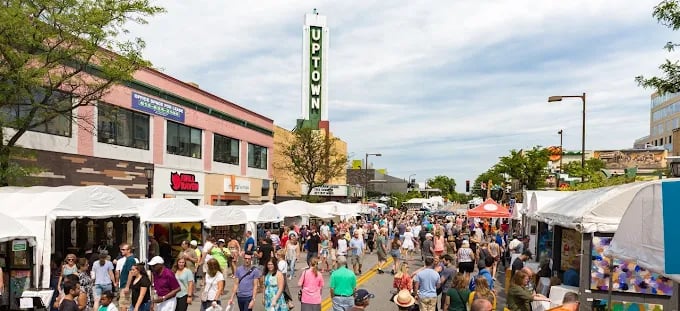
If you have lived in Southwest Minneapolis long enough to remember when the Uptown Art Fair meant closing Hennepin and Lake for a weekend, you probably went looking for it in the usual spot this year out of pure muscle memory. It wasn't there. After sitting out roughly two years, the fair returned August 7 through 9, 2026, not on the street corridor that gave it its name for more than six decades, but along Lake of the Isles and The Mall. Locally it's being called Art on the Isles almost as often as it's being called the Uptown Art Fair, and that double name is doing a lot of work.
This matters for anyone who lives between Bde Maka Ska and Lake Harriet, because the move wasn't cosmetic. It's a bet, made in public, about which asset actually carries this neighborhood now: the commercial street or the water it sits next to. The rest of the summer gives you a pretty good answer.
What Actually Moved
The fair that returned this month was smaller and repositioned by design. Instead of spilling down Hennepin and Lake Street, it set up around 200 juried artists along Lake of the Isles and The Mall, with hours running Friday 1 to 7 p.m., Saturday 10 a.m. to 6 p.m., and Sunday 10 a.m. to 4 p.m. The Friday before it opened, ARTCRANK Revival ran a separate, free event at Venture Bikes Midtown on the Midtown Greenway, projecting bike-culture screenprints onto the building through the evening, a small signal that the neighborhood's cultural calendar didn't wait for the main event to start improvising.
The Uptown Association, under newer executive director Stefani Pennaz, framed the relocation as more than a scheduling fix. Half of net proceeds are being routed into a new Uptown District Reinvestment Initiative aimed at beautification, safety, and small business support, and the fair's return leaned on a public-private safety partnership rather than assuming the crowds would simply show up the way they used to. Pennaz told Southwest Voices that organizers are "building real momentum and making sure visitors across the region know Uptown is ready to welcome them back." That's the language of a corridor that knows it has to earn its foot traffic again, not one that assumes an institution's name is enough to bring people back on its own.
The Street Didn't Wait for Permission
Here's the part that undercuts the tidy story. While the fair spent two years figuring out where it belonged, the restaurant scene along Lake Harriet Parkway and through Linden Hills didn't pause for anyone's reinvestment plan.
Chef Daniel del Prado, who came up cooking under Isaac Becker at Bar La Grassa in the North Loop starting in 2009, opened his own restaurant Martina in Linden Hills, an Argentinian-inspired wood-fire concept, and followed it about a year later with Colita, an Oaxacan-influenced Mexican spot, according to OpenTable's neighborhood guide. Neither of those needed a festival to justify its existence. Around them, the corridor kept filling in with Tenant Restaurant, Picnic Linden Hills, Saturday Dumpling, and the long-running Broders' Pasta Bar, all doing business within a few blocks of each other along Lake Harriet Parkway. Star Tribune's ongoing roundup of Twin Cities restaurant openings this year also tracked Uptown additions like Tiki Tom's Thai moving into the former Pinoli and Amore Victoria space on Lake Street, and a second Arizona Taco Co. location filling the old Arts & Rec and Libertine spot, evidence that operators were betting on Uptown foot traffic on their own timeline, independent of whether the art fair ever came back at all.
That's the piece a headline about "the fair is back" leaves out. The neighborhood's food economy didn't need an anchor event to recover. It recovered restaurant by restaurant, lease by lease, while the civic institution figured out its own second act somewhere else entirely.
The Older Rhythm Never Left
If the art fair's return is the neighborhood's experiment, the rest of the summer calendar is its control group, and it's been running the whole time without a rebrand.
The Linden Hills Farmers Market has kept its own schedule every Sunday from 10 a.m. to 1 p.m., May through October, in the parking lot at Settergrens of Linden Hills, drawing more than 45 local growers, makers, and musicians on a given week, according to the market's own site. No hiatus, no relocation, no reinvestment initiative required. It's the same low-key transaction it's been for years: farmers show up, neighbors show up, nobody has to be convinced.
A ten-minute walk east, Lake Harriet keeps its own version of that consistency. Free concerts run nearly every summer evening at the Lake Harriet Bandshell, and the current 1986 structure is actually the fifth bandshell built on that site, according to Meet Minneapolis, the city's official visitor guide. Bread & Pickle still serves scones and sandwiches out of the building next to the bandshell, and the Como-Harriet Streetcar still runs its short scenic route between Lake Harriet and Bde Maka Ska on weekends through October. None of it needed reinventing this decade. It just needed to keep showing up.
What the Contrast Actually Tells You
Put those two stories side by side and the neighborhood's real character comes into focus. The institution with a name and a legacy, the one that could plausibly claim to define Uptown, had to relocate, restructure its funding, and bring in a private security partner just to reopen its doors. Meanwhile the businesses without a legacy to lean on, the newer restaurants and the decades-old Sunday market, kept operating on their own steam the entire time the fair was gone.
That's not a knock on the fair. Bringing back a 60-year event after a two-year gap, in a new location, with a reinvestment plan attached, is a genuinely hard civic lift, and it's worth watching whether Art on the Isles becomes the corridor's new anchor or just its most visible weekend. But if you're the kind of resident who wants to know what actually keeps this stretch of Southwest Minneapolis interesting on an ordinary Tuesday in late August, the answer isn't the festival calendar. It's a farmers market that sets up in the same parking lot every Sunday and a bandshell that's been rebuilt five times and never stopped playing music.
That's worth knowing if you already live here, and it's worth knowing if you're the kind of person who pays attention to which neighborhoods keep their character even when their biggest annual event has to reinvent itself to survive.
If you're thinking about what a stretch of the city like this means for your own next move, or you just want a second opinion from people who actually watch these blocks change year over year, Move Real Estate is happy to talk it through. Let's Connect.